
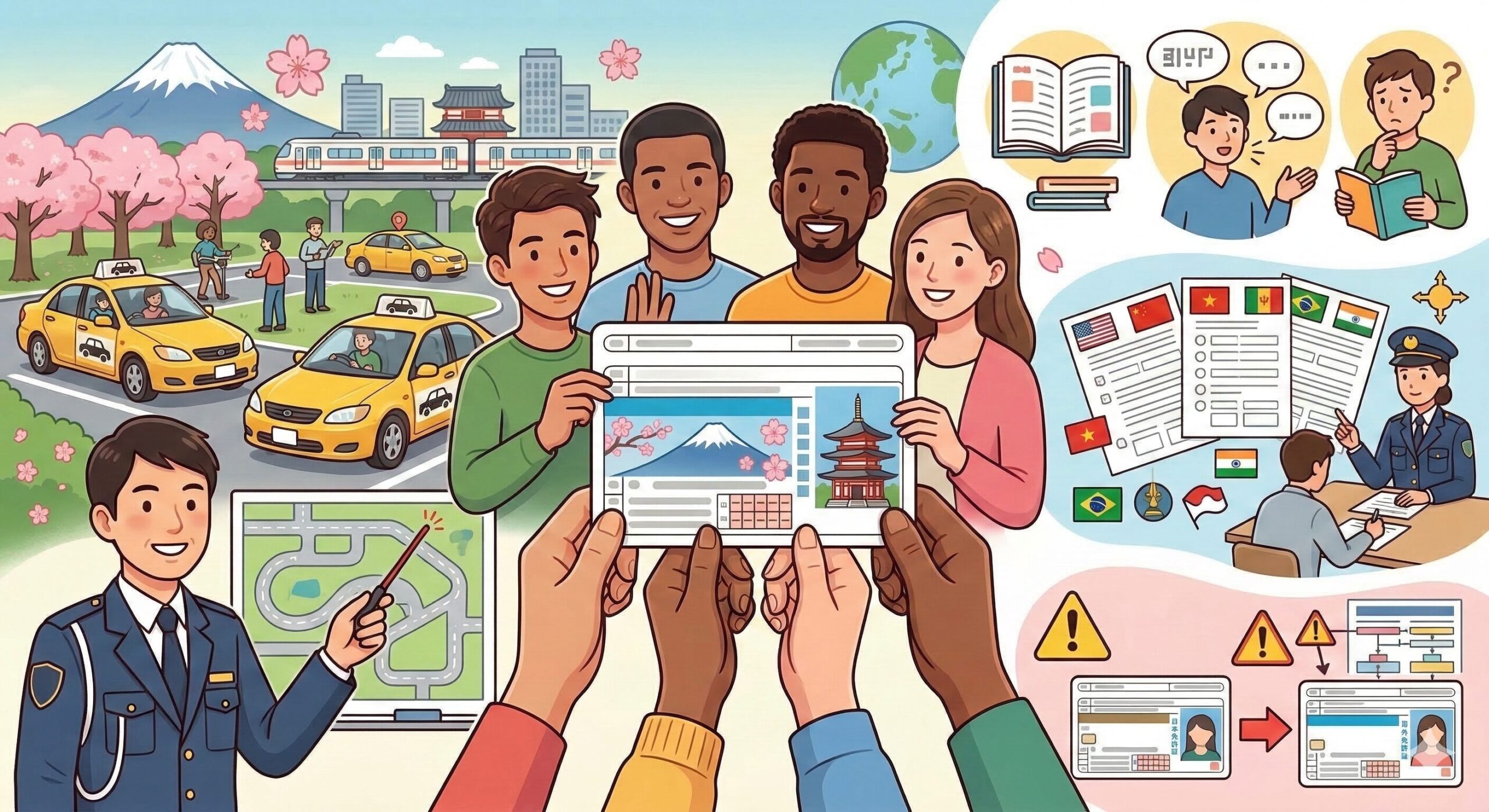
Having a driver’s license in Japan drastically expands your mobility and makes daily life much more convenient. Many foreigners living here think, “I want to get a regular car license in Japan!”
However, the biggest concern when attending a Japanese driving school is often the “language barrier.” In this article, an active driving instructor will explain the Japanese driving school system in detail and show you the best way to get your license based on your Japanese proficiency level (Fluent / N3 level / Zero Japanese).
1. Two Main Types of Driving Schools in Japan
When looking for a driving school to get your license, the first important thing to know is that there are two types of driving schools in Japan:
- ① Designated Driving Schools (Shitei Jidosha Kyoshujo) These are driving schools officially certified by the Public Safety Commission (the police). Here, you can not only practice driving but also take the skill tests for your learner’s permit and graduation. If you graduate from a designated school, you are exempt from the practical driving test at the final Driver’s License Center. You will only need to pass the final written exam to get your license.
- ② Non-Designated Driving Schools (Todokede Jidosha Kyoshujo) These are uncertified schools where you only practice driving and study the traffic rules. You must take all exams—both the learner’s permit and the final license (both practical and written)—directly at the Driver’s License Center. The practical test at the center has extremely strict grading standards, and many people fail repeatedly, making it a very high hurdle for beginners.
Note: For this article, we will explain the process assuming you attend a “Designated Driving School,” which is the most common route.
2. Steps to Get a License at a Designated Driving School (AT Cars)
Here are the basic steps to obtain a regular car license (Automatic Transmission):
① Stage 1 (Driving on the School Course)
- Practical Driving: 12 hours (Learning basic car operations on the school’s closed course).
- Classroom Lectures: 10 hours (Learning traffic rules).
② Driving Skills Test & Learner’s Permit Written Test These tests are taken at the end of Stage 1. If you pass both the driving test and the written test, you will receive a “Learner’s Permit” (Kari-menkyo), which allows you to practice on public roads.
③ Stage 2 (Driving on Public Roads)
- Practical Driving: 19 hours (Practicing practical driving on actual public roads).
- Classroom Lectures: 16 hours (Learning advanced traffic rules and safety knowledge).
④ Graduation Test (Sotsugyo Kentei) This is the final driving test at the school (driving on public roads and practicing reverse parking inside the school). If you pass, you “graduate” from the driving school.
⑤ Final Written Exam at the Driver’s License Center After graduating, you go to the “Driver’s License Center” in your area and take the final written exam. If you pass, your Japanese driver’s license will finally be issued!
3. How to Attend a Driving School Based on Your Japanese Level
The best approach changes depending on your Japanese ability. Find the pattern that fits you from the three options below:
Pattern A: You can speak Japanese without problems
If you have no trouble holding conversations, you can smoothly take the practical driving lessons at any school. The key point is your “reading and writing” level.
- If you are good at reading and writing: You can choose any driving school, just like Japanese students.
- If you are not good at reading and writing: Classroom lectures are generally conducted entirely in Japanese. Some schools provide English or Chinese textbooks, but most do not support other languages. 【An Insider Trick from an Instructor】 The “Learner’s Permit Written Test” held at the driving school is often only available in Japanese, English, and Chinese. However, the official “Driver’s License Center” in each prefecture may offer the written test in up to 20 different languages. Therefore, ask the driving school staff: “I want to take only the Learner’s Permit written test at the Driver’s License Center in my native language.” If you pass the permit test at the center, you can return to the driving school to continue Stage 2 on public roads. Then, for your final exam after graduation, you can simply take it in your native language at the License Center again.
Pattern B: You have “N3 Level” Japanese
Basically, you can follow the same route as “Pattern A.” If you can have daily conversations, you should be able to understand the driving instructor’s directions. However, for safety reasons, some driving schools may refuse to accept students at the N3 level. We strongly recommend going directly to the reception of your nearest driving school and consulting with them in person.
Pattern C: You cannot speak Japanese at all
Unfortunately, if you do not understand Japanese at all, it is extremely difficult to get a license from scratch at a typical Japanese driving school. But don’t give up! You have the following options:
- Look for a multilingual driving school Although few, there are driving schools with foreign language-speaking instructors. The surest way is to contact your local Driver’s License Center and ask them to introduce a school that supports foreign languages.
- Convert your home country’s license to a Japanese one (Gaimen Kirikae) If you already have a driver’s license from your home country, you can use the “Gaimen Kirikae” (Foreign License Conversion) system.
【Important Notice About Foreign License Conversion】 As a general rule, you can apply for conversion if you have a “valid driver’s license” and “proof that you stayed in that country for at least 3 months after obtaining the license.” However, from October 2025, the standards for converting to a Japanese license (knowledge and skill confirmation tests) have changed, making it much harder to pass than before. Also, please note that you cannot convert your license in the following cases:
- Licenses issued in countries not part of the Geneva Convention (1949).
- If you cannot prove your stay in the issuing country (total of 3 months or more) after obtaining the license.
- An expired license, or a license for which a Japanese translation cannot be issued.
For a detailed explanation of the stricter rules for foreign license conversion, please read this article: https://online-ds.jp/2025/07/25/gaimen-change/
Conclusion
Getting a driver’s license in Japan might seem complicated, but if you follow the right steps suited to your Japanese level, it is definitely possible. First, visit your local driving school or Driver’s License Center and consult them about your situation. We are cheering for the day you can drive safely and freely on Japanese roads!